
Monday, January 13, 2014

Friday, January 10, 2014
2014: Resolving to Be Better to My Batteries
With the advent of the new year it's a good time to give your flooded lead acid batteries a little love; maybe not the kind of love one seeks beneath the mistletoe, but something akin to opening the battery box and casting a glance down each cell.

I started the new year by topping off all of the cells in our battery bank. I couldn't remember when I last checked them but it must have been a while because they were certainly thirsty. Some of my customers with off-grid or battery backup systems have inspired me to do better in 2014. Many keep a notepad or tablet by their battery box for the sake of recording each watering and equalize session.
Batteries are a little like plants on your windowsill. They will treat you well if you give them a little care from time to time. We have some beautiful orchids that my wife waters and feeds. She takes good care of them and they keep returning blooms (even now in the dead of winter!). Determining the condition of batteries in a box isn't as simple as a glance at the windowsill, but a diary of care that's easy to pickup and look through can be a good start toward that regular maintenance.
Ron is one of the people who I always think of when my mind wanders to examples of battery care excellence. He lives way off the grid in West Virginia.
Thursday, November 21, 2013
Preston, Co West Virginia's Newest Power Plant

Wednesday, June 26, 2013
Reading Your Net Meter from FirstEnergy (MonPower and Potomac Edison Customer Generators)
The bi-directional meter that I see most often used by FirstEnergy in West Virginia and Maryland is pictured below. These meters were issued beginning in 2011 ("New Net Meters for First Energy Customers"). The meter rotates through three screens coded 04, 40, 01. The meter also has a dial emulator which is a series of digital blocks and an arrow which march to the right or left to indicate whether power is being pushed out to the utility or pulled in to the residence.
This photo series is from June 26, 2013 @ 5:30PM. The dial emulator is pointing to the left which means that our solar modules are pushing power back to FirstEnergy.


This photo series is from June 26, 2013 @ 5:30PM. The dial emulator is pointing to the left which means that our solar modules are pushing power back to FirstEnergy.

Code 01 = The "Net" kWh that I am billed for

Code 04 = The kWh pulled from the utility

Code 40 = The kWh that has pushed back to the utility
This style meter makes it easy for meter technician and customer alike to see the exchange of kWh.
Code 04 - Code 40 = Code 01
or, in our example here....
4786 kWh - 2006 kWh = 2779 kWh
Code 01 is really the only number used for determining how much you owe. If the value is greater than the prior month then you owe money. Likewise, if the number is smaller than the previous month you have gained credits and you only owe for the base charge.
It's important to note that the kWh pushed back to the utility (Code 40) is not synonymous with the total power produced by our solar PV system. Some of the power that we produce is gobbled up immediately in our house - as soon as it is generated, before it even gets to the utility meter.. The leftover solar generation (the excess) is what gets pushed back to the utility.
Monday, April 8, 2013
I was invited to take a look at an off-grid home in Pendelton Co., West Virginia this past weekend. Imagine running across this in the midst of fields and forests.................!

Our friend Jason recently turned us onto a great website that features special off the grid places like this one from across the globe. Free Cabin Porn is well worth a look if you like to daydream about being somewhere that is pretty much just awesome. There are lots of off-grid homes pictured and the site really does feature eye candy that spans our corner of the Appalachians all the way to Austrailia, Norway and beyond.

Our friend Jason recently turned us onto a great website that features special off the grid places like this one from across the globe. Free Cabin Porn is well worth a look if you like to daydream about being somewhere that is pretty much just awesome. There are lots of off-grid homes pictured and the site really does feature eye candy that spans our corner of the Appalachians all the way to Austrailia, Norway and beyond.
Monday, March 18, 2013
History of Off-grid Inverter Companies
Posted at MidNite Solar is the story of off-grid inverter manufacturers in the Northwest U.S. The story is short, interesting and if you live in a home that is off-grid or has battery backup then you likely have a piece of inverter equipment (Outback, Trace, Xantrex, Schneider) that had its start thanks to these folks.


A Xantrex SW series inverter (top) with an Outback charge controller (right) and breaker enclosures at an off-grid home in Preston County, West Virginia
Wednesday, February 20, 2013
We Use Creek Water to Power Our House
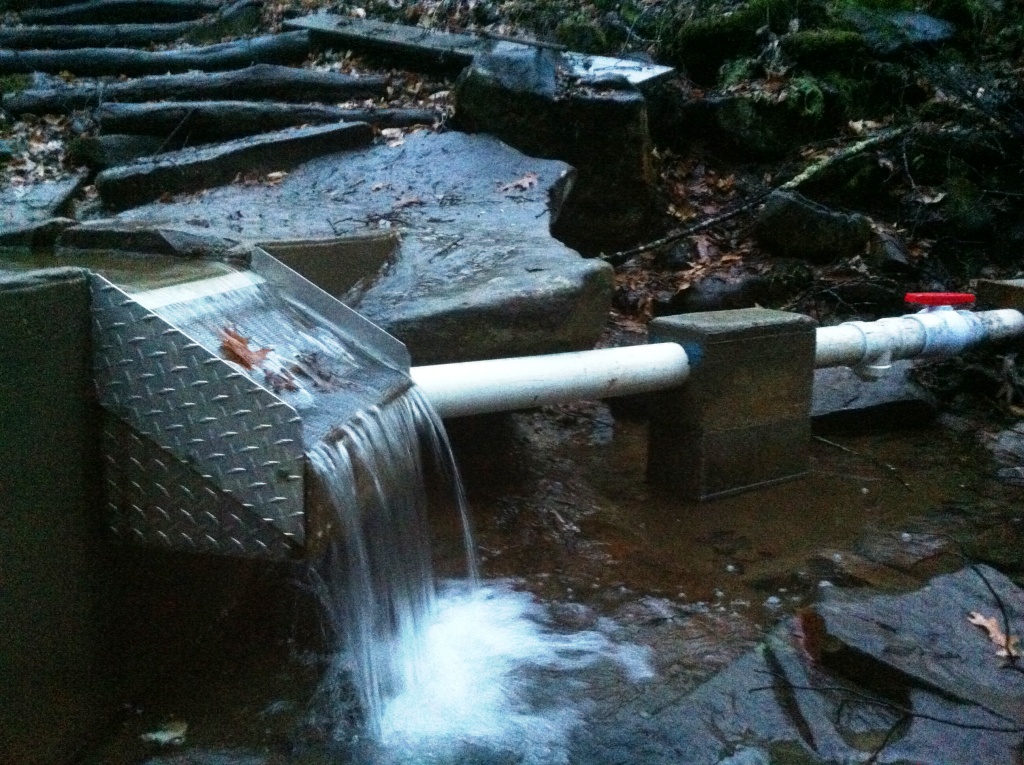
Some readers of the Charleston Gazette may have caught an op/ed piece by Mickey Janowski back on January 4, 2013. His home has now been powered for more than 110 days without interruption and with power to spare.
We use creek water to power our house
Editor:
I live up a holler that has a nice little creek in Webster County. I'm not connected to the electric grid and for years have used photovoltaic panels for our electricity. During prolonged times of rain, snow and diminished sunlight, I used to have to fire up the nasty, noisy, stinky, fossil fuel generator to recharge the house's deep-cycle batteries.
Not lately. On Oct. 29, the day that Hurricane Sandy's related snowstorm hit (We got just over three feet), my mini hydro-electric generator, the "Stream Engine," began tapping energy of the water flowing down the mountain. Almost three weeks of snowmelt has provided more electricity than we can use. The excess powers a space heater.
I'd like to thank Matt Sherald of PIMBY Energy in Thomas for the electrical work, Marvin Woodie and Larry Agnew from Conn-Weld Industries in Princeton for the design and fabrication of the intake screen, and Paul Cunningham of Energy Systems and Design LTD, builder of the Stream Engine.
It added another aspect as to how I look at the water in my creek. It's power to be converted to electricity, with virtually zero impact on the environment. A little diversion and it's back in the creek. Let it rain (or snow).
Mickey Janowski
Webster Springs

Mickey getting his feet wet (nice hat!)
Subscribe to:
Posts (Atom)
