Showing posts with label solar. Show all posts

Friday, January 19, 2018

Keeping it Neat: Off-grid Samlex Inverter Installation w/ E-Panel


Chuck finalizing the installation of six SolarWorld 300W solar PV modules.  The Samlex EVO4024 and battery bank are housed inside this nice pre-built shed.

Samlex wasn't even on my radar until I got a call late last summer from a couple who had purchased a Samlex EVO4024 inverter for their off-grid home near Belington, WV.  Up to that point I had mostly used Outback and Schneider/Xantrex brand equipment for off-grid jobs.  Chuck and Deb who had this Samlex unit had also purchased a bank of Trojan batteries and a Generac 15kW EcoGen generator.  When they called they were in search of someone who could pull all the pieces together into a functioning off-grid electrical system.
Part of pulling the pieces together was the addition of a MidNite Solar E-Panel.  Not to get too technical about things, but I find it's common for folks who source their own equipment to overlook key switch gear and enclosures that ultimately make a system safe, serviceable and code compliant.
Looking at the EVO4024 for the first time I was cognizant that the unit, as it is sold, could not alone yield a polished final installation.  Basically, it was lacking a cover for the large DC cables that connect the inverter back to the batteries.  This is fairly common among inverter manufactures, but does not yield a safe or code compliant installation (it also leaves things looking sloppy).
Many off-grid inverter manufacturers offer units without any enclosure to protect the DC cabling.  Most, however, do offer an optional enclosure that can be purchased separately and is purpose built to be paired with their inverter equipment.  These optional enclosures commonly include space for disconnects and breakers that protect the wires and the electronics in the system.  Samlex does not offer something like this and I was a little perplexed after I first gave their website a once over and concluded that I would have to look elsewhere.

The big dark blue box is the EVO4024 inverter.  It is mounted to the E-Panel which is affixed to the wall.  The MidNite E-Panel includes the gray portion below the inverter (this limits access to those DC cables).  The small black "thermostat" at the right is the control panel for the inverter.  The larger black piece of electronics is an Outback FM80 solar charge controller.

MidNite Solar would win an award as the most creative manufacturer of solar related enclosures and electronics equipment.  They were the next place I looked for an enclosure that could be paired with the EVO4024 inverter and sure enough they had something tailor-made to fit!  MidNite Solar has been manufacturing E-Panels for maybe almost ten years - I can't remember for sure.  These E-Panels were created as a way to minimize the footprint of an inverter installation as well as the cost.  I don't always use E-Panels because the wiring space can get tight, but they certainly have their place and they are the only game in town if you want to make a Samlex EVO4024 installation safe and sharp looking.


This series of photos is probably a better illustration of how the E-Panel consolidates the AC and DC wiring as well as the associated breakers.  Note the big red breaker guard for the main DC cables on the left side of the E-Panel.

My experience with the Samlex EVO4024 was great.  The unit has a very nice relay that allows it to trigger the EcoGen generator to fire up automatically without the addition of any other electronics  Another plus for Samlex is the comparatively low cost of the system control panel.  The cost of inverter control panels has become a major hang-up of mine.  Some control panels cost more than $400!  That's a chunk of change for something that really resembles a beefed up thermostat.  Anyway, the controller for the EVO4024 costs less than $200.  It's probably the cheapest controller out there.  Finally, and most importantly, the technical support from Samlex was the best I have had from any inverter manufacturer.  By "best" I mean that there was no time wasted on hold and the support staff gave me the impression of being upper-tier right off the bat.  The technician who I spoke with was knowledgeable, polite and I got my questions answered while I was in the field.  I called multiple times and there was no deviation from this stellar service.


Monday, January 15, 2018

Winter Sun | High Voltage

Well it's January 15 and you can already tell that the days are getting longer.  The cold temps have conspired with a few really beautiful sunny days to make for some good peak PV power production.  Those bluebird days where the snow reflects the sun and the temps stay well below freezing are some of the best days for solar.

People are often surprised to learn that colder temps really enhance the output from a solar PV system.  In fact, cold temps are a primary consideration when designing a system.  The voltage from a solar PV panel can increase 14% or more as the temperature decreases.  If you fail to account for this during the design of the system you may goose the charge control or inverter equipment with a voltage that exceeds the operating limits.  Yikes!

It being winter, I like to roll out my mother-in-law's favorite ski video.  So far, this winter has already bested the last two for quality skiing days.  Hope there are many yet to come this season.


Wednesday, July 12, 2017

What Happens When You Shoot A Solar Panel???


I don't do as many educational events as I used to.  But, speaking to groups about solar energy occasionally did put me in the position of trying to field questions about solar panel durability; you know, hail, wind, bullets. 
 
There was often some jackass at the back of the room who would ask, "What happens if you shoot 'em?"

Like a lot of stuff, solar panels break when they are shot.

The warning signal at the Randolph/Pendleton County line on U.S. 33 between Harman and Seneca Rocks was disabled by somebody abusing their Second Amendment right several months ago.  Recently I noted that the shattered front glass on the module had weakened enough that wind was able to blow the entire assembly out of the aluminum frame. 


The sandwich of materials has pretty good adhesion even after being blown out of the aluminum frame.  By "sandwich" I am referring to the glass on top + silver circuits +  dark colored solar wafers + white tedlar backing.  The glass provides protection for the silicon wafers and circuitry that you can see above.  Most solar panels have glass that is rated to withstand the impact of 1" hail at 50 mph.  The glass accounts for the rigidity of the solar panel and much of its weight.


No more warning lights.  The blinking lights were powered by the solar equipment.  This is a no-joke descent with several hairpin curves and a couple of shear drop offs. 


Wednesday, May 3, 2017

Honey Factory in Job, WV


Busy as bees......
These hives are the property of a new distillery, Still Hollow, that's undergoing construction in greater Job, WV.  Listening to the buzz from the sun warmed hives makes me think a bit about the frenzy of electrons  moving through a solar PV panel on a bright spring day!

Wednesday, April 26, 2017

Passivhause Solar PV: Garrett County, Maryland


Homeowners, Bill and Fran, opted to add solar PV as part of their new home.  They elected to build the house to a rigorous Passive House standard to minimize the energy footprint of the home and ensure that their new home would be comfortable and inexpensive to operate.

The 9-kW solar array is made up of thirty SolarWorld 300W modules.  The solar modules are mounted to the standing seam roof with S-5 clamps which eliminate the need for drilling through the metal roofing material.  SMA inverter equipment converts the DC power from the solar to AC which powers household circuits and turns the utility meter backward.   Special thanks to Larry at CHIPS Network for his help with connecting the inverters to the world wide web.  Production data like that shown below (sunny day in April!) is uploaded and stored on the SunnyPortal website.


Thursday, December 15, 2016

Grid-tie Solar Power System with Battery-backup in Beverly, WV


Sixteen SolarWorld PV modules back-feed power to the electric utility during normal operation.  During an outage the battery bank and electronics in the basement supply power to selected critical loads.  The battery bank has eight large Trojan deep-cycle batteries.  The backup system can supply 21 amps (240V) and the stored power is close to 17 kWh.  In a prolonged outage the solar will help charge the battery bank as though the home were off-grid.


Monday, June 27, 2016

Sea Container as Off-grid Solar Power Plant - Somewhere in West Virginia


 5.4-kW PV on a 20' can.  Apple juice concentrate was originally imported from overseas in this container.

Outback Power electronics and Trojan batteries are stored inside.  The battery bank can provide 13.3 kWh at 50% DOD.  The inverter produces 120VAC with a max wattage of 3,500W.  There is a Trimetric battery monitor included to aid in the maintenance of the system

The system was built for West Virginia State University as a power supply for an agricultural project near Nowhere, West Virginia (or is that, Somewhere).  Wherever it is, it's out there and it's a long way to a utility pole.


Saturday, April 16, 2016

Davis & Elkins College: Spring Green-up on the Harper-McNeeley Auditorium Roof

 
Had a great student project yesterday with members of the Greenworks! Club at Davis & Elkins College.


They installed thirty 285-watt SolarWorld modules on the roof of the campus auditorium.  This builds on the twelve modules that were previously installed at the campus' science center last year.


The students at this small liberal arts college in Elkins, WV have, for the second year running, installed more solar PV capacity than any other residential college in West Virginia.  The enthusiasm and funding for their projects comes directly from the students.


Students initially identified locations on campus where they thought solar might be a good fit.  We met last fall to look at one of the better locations - the Harper-McNeeley Auditorium.  Turns out that the site was sweet!


It is always a pleasure to work with the D&E students.  They are hardworking, smart, and affable.  Our installation of thirty solar panels, thirty Enphase microinverters, and the associated wiring was polished off in record time.  Everyone ended the day sun-kissed and pleased with the result.


Wednesday, February 24, 2016

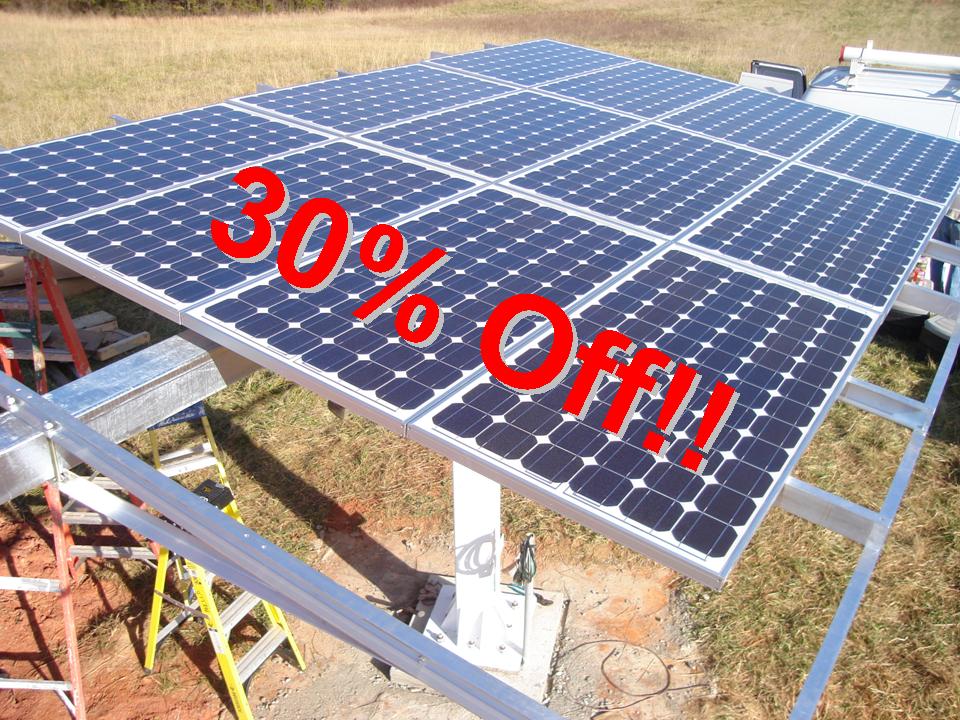
30% Federal Tax Credit Extended for Solar Installations


I thought it might not happen.

I could totally imagine 2016 being THE END of the incredibly effective Federal Investment Tax Credit (ITC).

I was hesitant to believe that the U.S. Congress could pull it together to extend the legislation that has been largely responsible for driving expansion of solar in the U.S. over the last seven years. 

http://www.seia.org/research-resources/solar-industry-data

I was wrong.

The Congress did something productive (their machinations were lubricated by the potential for oil exports).

They extended the ITC 30% tax credit for five more years.

That's a 30% tax credit on the installed cost of the entire system!  

THE WHOLE ENCHILADA!!

INCREDIBLE!

Friday, November 13, 2015

Pole-barns in Space!


(Click image to enlarge)

This week's installation was at Green Heron Gardens (near Salem, WV).  The pole barn below has housed horses, boats, and VW campers over the years.  It's roof  is now home to a 6.84-kW PV array - twenty-four SolarWorld solar PV panels.

  
Green Heron Gardens offers herbal products for both body and palate.  They've been in business almost 25-years.  I've included a sample from their mail order catalog below.
(Click image to enlarge)


Past customers Dan and Autumn helped me attach the racking and get the panels on the roof.. During much of the year they stay busy with their landscaping company Goldenseal Garden Care.  You couldn't ask for better help either on the roof or in the yard.


Tuesday, November 29, 2011

New Net Meters for First Energy Customers


Customer-generator n. Utility jargon for your neighbors with solar on the roof

Seen the new net meters? New and old net metering customers in First Energy's MonPower and Potomac Edison service areas of West Virginia and Maryland are being fitted with improved metering equipment to help track customer generated power as it is pushed back onto the grid.


New net meter for a First Energy customer (note, the code is 01 and the reading is 00000 kWh). Being brand new it has not had time to record any energy, but the small arrow below the 01 points to the right indicating that energy is moving from the utility grid to the home.

The new meters began to appear in July. I've been asked by several customers about the different flashing codes on the new meters. The First Energy folks have been getting a lot of calls too. To help their customers get a handle on reading the new net meter they produced a nice pdf which you can view here. The pdf has illustrations and explanations for what the meter is measuring and reporting.

I checked my new net meter a couple of days after it was installed this past summer. It flashed through three separate screens. Each screen references a code and displays a reading (in kWh). Here's what the meter read and what it means:

Code Reading Meaning
01 4 Net kWh that I owe money for (14-10 = 4 kWh)
04 14 Total kWh that my home has pulled in from the utility grid (14 kWh)
40 10 Total kWh that my solar pushed back onto the utility grid (10 kWh)

Another cool aspect to these meters is the dial emulator which is really an arrow that displays at the bottom of each meter screen demonstrating the direction that power is presently traveling. As you look at your net meter the arrow will point to the right if you are pulling in power from the utility grid. It will point to the left if you are pushing power back. The arrow will display more or less quickly depending on the amount of power that is running through the meter. The old dial-style mechanical meters would spin to the right or left, faster or slower, in a similar fashion.

Friday, July 23, 2010

Wind Turbine in Highland County, VA

I was over in Highland County today and was again reminded about how truly beautiful that area is. The following video shows a 2.5kW turbine that is located on the flank of Snowy Mountain. You can read more about this turbine by clicking here.

The video shows the turbine coming to life and then reaching a fairly good speed. It is a nice progression and the video shows the same machine from a couple of angles. The machine weight is a bit more than 300 lbs. It is an ARE110 with a blade length of about 6'. The nameplate rating of 2.5kW denotes the amount of power that the machine can output at peak wind speed (~26mph). If the wind speed is less, then the resulting power will also be less.


This turbine was originally installed in the Spring of 2009 by PIMBY Energy. It is on a 100' tower and uses an 8' stub tower to provide additional clearance for the turbine blades